
 |
|||||||
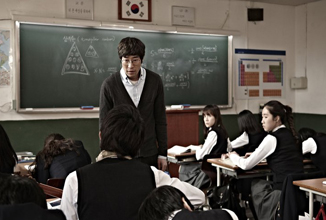
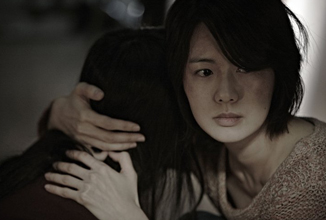
Synopsis: Seok-go (Ryoo Seung-beom) is a quiet and seemingly unassuming maths teacher living alone in a Seoul apartment block. Deeply enamoured with his neighbour, Hwa-seon (Lee Yo-won), he visits the cafe where she works each lunchtime without fail - always ordering the same takeaway food - but, try as he might, his shyness repeatedly prevents him from connecting with her on an emotional level; managing only an almost embarrassed 'hello' and 'thank you' he walks away frustrated and unfulfilled on each occasion.
Review: What would you be prepared to do for love? More than that, if someone told you they "did it for love" would you assume they meant love for someone or love from someone?
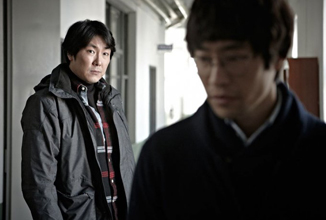
More than once during the course of the film, reference is made to a classical mathematical theorem that Seok-go has been obsessed with trying to prove since his school days. However, in helping Hwa-seon hide her crime his focus increasingly shifts from a sole preoccupation with the concept of a Perfect Number to a deep-rooted intellectual and emotional need to maintain her alibi and thereby create the perfect murder. This is added to yet further by the third piece in the character puzzle; that of Min-beom (Jo Jin-woong), the police detective in charge of the case who is also an old school friend of Seok-go: Ultimately, for all his intelligence Seok-go is set to find an answer he didn't even know he was looking for... the answer to the question "In a battle between heart and mind, which will win?"
Download+18+kamini+the+bhabhi+next+door+20+verified | Ultimate & LegitIndian families are known for their love of traditions and celebrations. Festivals like Diwali, Holi, and Navratri are joyous occasions that bring the family together. The home is filled with the aroma of traditional sweets, decorations, and colorful attire. These celebrations are an integral part of Indian culture, strengthening family bonds and creating lasting memories. In India, the joint family system is a prevalent and enduring institution. Several generations of a family live together under one roof, sharing joys and sorrows, and supporting each other through thick and thin. This system fosters a sense of unity, cooperation, and interdependence among family members. The elderly members, revered for their wisdom and experience, play a vital role in passing down traditions, values, and cultural heritage to the younger generations. The Indian family lifestyle is a rich and vibrant tapestry, woven with threads of tradition, culture, and values. The daily life stories of Indian families reveal a deep sense of unity, cooperation, and respect, which are the hallmarks of this unique institution. As India continues to evolve and grow, its family system will undoubtedly adapt, but its core values and traditions will remain an integral part of its identity. download+18+kamini+the+bhabhi+next+door+20+verified In many Indian families, the mother plays a pivotal role in managing the household and taking care of the children. The father, often the breadwinner, works hard to provide for the family, while the children are expected to excel in their studies and help with household responsibilities. The elderly members, with their wealth of experience, offer guidance and support to the family. Food plays a vital role in Indian family life. Traditional Indian cuisine, with its diverse flavors and spices, is an essential part of family gatherings and celebrations. The family often comes together to share meals, which are a time for bonding and conversation. In many Indian households, the mother or grandmother is the primary cook, using secret recipes passed down through generations. Indian families are known for their love of Like any other family system, the Indian family faces its share of challenges. With urbanization and modernization, many Indian families are moving away from the traditional joint family system. The influence of Western culture is also evident, with many younger generations adopting more individualistic values. However, despite these changes, the Indian family remains strong and resilient, adapting to the demands of a rapidly changing world. India, a land of diverse cultures, traditions, and values, is home to a unique and vibrant family lifestyle that is deeply rooted in its rich heritage. The Indian family, a fundamental unit of society, is a microcosm of the country's multifaceted identity. With its strong bonds, rich traditions, and resilience, the Indian family is a fascinating subject to explore. These celebrations are an integral part of Indian In Indian families, respect and hierarchy are deeply ingrained. Children are taught from a young age to respect their elders, using honorifics like "ji" or "sahib" to address them. The elderly members are accorded a high level of respect, and their opinions are sought on important matters. This hierarchical structure helps maintain order and discipline within the family. A typical day in an Indian family begins early, with morning prayers, yoga, or meditation. The family comes together to share a hearty breakfast, often consisting of traditional dishes like idlis, dosas, or parathas. The day is filled with a mix of work, school, and household chores, with family members pitching in to help each other. DVD The DVD edition reviewed here is the Korean (Region 3) Art Service Limited Edition First Press version. The film itself is provided as an anamorphic transfer with an aspect ratio of 2.35:1 and there are no image artifacts (and no ghosting) present.
'Perfect Number'
- Commentary by director Bang Eun-jin, Ryoo Seung-beom and Jo Jin-woong
|
|||||||
All images © Art Service Review © Paul Quinn |
|||||||